The International Law Seminar was founded in 1965 at the Palais des Nations in Geneva with a clear and enduring mission: to provide a unique forum where emerging legal minds could engage directly with the institutions, practitioners, and ideas shaping international law. Organized by the European Office of the United Nations, it was designed for advanced students of the subject and young government officials responsible in their respective countries for dealing with questions of international law. Closely linked from the outset to the work of the ILC, the Seminar was built as a combination of academic rigour and practical exposure, offering participants the opportunity to experience international law not only as a discipline but as a living and evolving practice.
The early years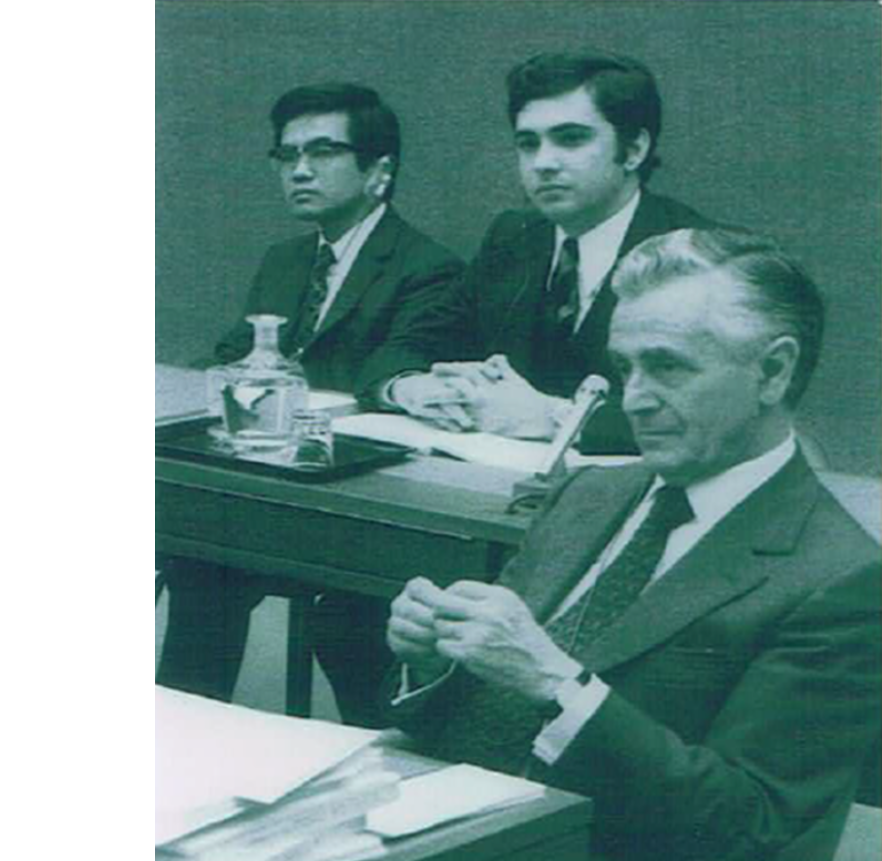
In its initial years, the Seminar welcomed a relatively small and predominantly regional group of participants. The first session, held from 10 to 21 May 1965, welcomed sixteen participants from thirteen different countries. The general subject of discussion was the law of treaties. The participants heard lectures by seven members of the Commission, two members of the Secretariat, and one professor from Geneva University. They also held discussions with lecturers and attended meetings of the ILC. The Commission, in its 1965 annual report, considered the Seminar “well organized and well administered” and a “useful experience” that should be convened again in conjunction with its future sessions. The UN General Assembly shared the same opinion in its resolution 2045 (XX) of 8 December 1965: future sessions should be held and should ensure the participation of a reasonable number of nationals from developing countries. In 1966, the Seminar was accordingly renewed and has been held each year ever since.
International Law Seminar and International Law Commission: A Shared Journey
The International Law Seminar has been closely linked to the International Law Commission since its creation. The Commission itself was established by the UN General Assembly in 1947 and was tasked with promoting the progressive development of international law and its codification. Held in conjunction with the ILC's annual session in Geneva, the Seminar allows participants to attend the Commission's public meetings and to follow a programme of lectures delivered by its members, alongside additional briefings on the work of other UN bodies and specialized agencies. This structure has remained the backbone of the Seminar for six decades, even as the topics discussed have shifted with the international legal agenda: from foundational questions of state responsibility and treaty law to issues relating to the protection of human rights, international criminal law, and contemporary issues concerning environmental governance, sea-level rise, and maritime security. Furthermore, this connection between the Seminar and the Commission is reflected not only in the programme but also in personal trajectories. Throughout the years, early participants of the Seminar have gone on to become members of the International Law Commission. In sixty years, 24 members or former members of the Commission have attended the International Law Seminar.
Making International Law Accessible
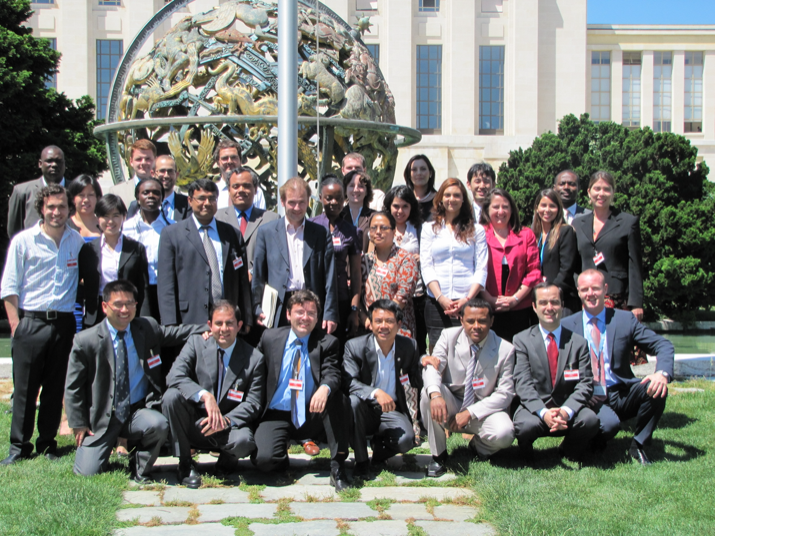 In 1965, when the Seminar held its first session, only one candidate from a developing country was able to participate, owing to the absence of fellowships. However, the International Law Commission, the United Nations General Assembly, and the Office of the United Nations at Geneva rapidly advocated for better geographical distribution of participants and greater diversity within the Seminar. A number of UN Member States and UNITAR soon made fellowships available to participants from developing countries to ensure that a lack of funds would not prevent anyone from taking part in the Seminar. When the Seminar celebrated its 10th anniversary in 1974, it had already welcomed participants of 85 different nationalities, and 107 out of 228 had benefited from fellowships. As of today, 843 participants have received financial support to cover their travel and/or accommodation expenses, accounting for more than 60 percent of all participants to date.
Recent Years
Since 1965, the Seminar has been held continuously (with the exception of 2020-2021 due to the COVID-19 outbreak). By the late twentieth century, the International Law Seminar had become a truly global programme, attracting participants from an increasingly diverse range of countries and legal traditions. Since its inception, 1,397 participants from 180 countries have taken part in the Seminar, reflecting its wide international reach and enduring relevance. This expansion mirrors both the growing role of newer generations in shaping international law and the Seminar’s reputation as a gateway to the international legal community.
The Seminar In Numbers
 Since the beginning, the International Law Seminar has brought together a diverse community of postgraduate students, emerging scholars, government officials, and young practitioners, including 470 women (33.6%) and 927 men (66.4%). The organizers remain committed to advancing gender balance among participants, and recent sessions have reflected this objective through more balanced proportions of women and men. To promote inclusive participation, 843 participants (60.3%) have received a stipend, enabling qualified candidates from all regions and backgrounds to attend.
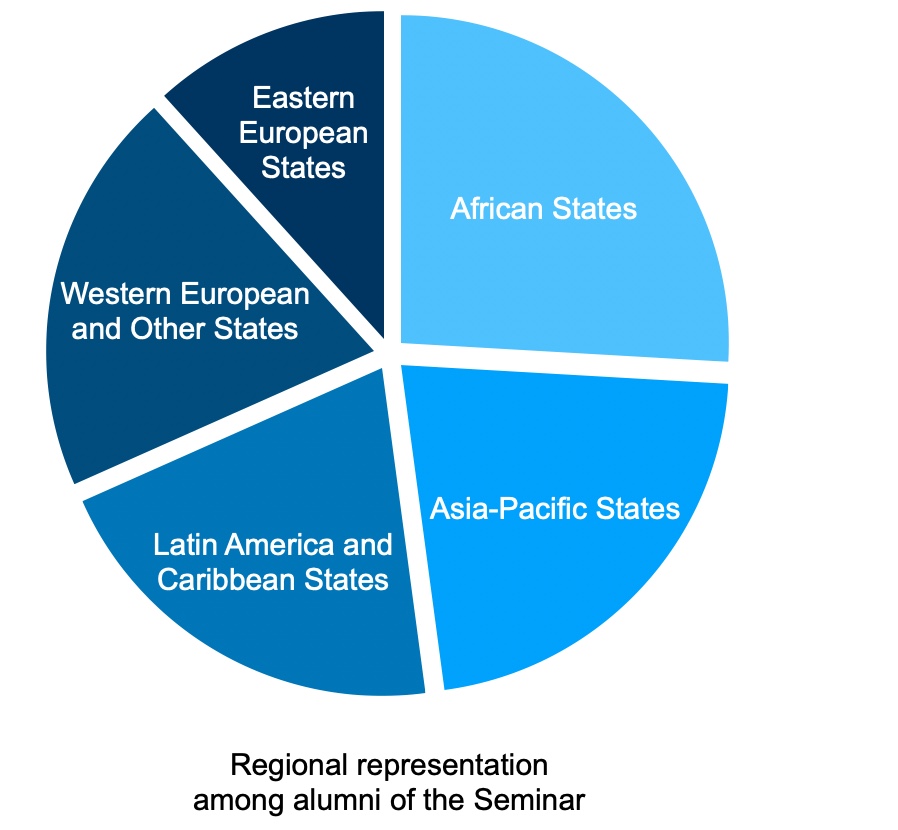
In terms of geographical diversity, the Seminar has attracted participants from 180 countries, reflecting its truly global character. Regional representation, based on the United Nations Regional Groups of Member States, includes 361 participants from African States (25.8%), 306 from Asia-Pacific States (21.9%), 285 from Latin American and Caribbean States (20.4%), 278 from Western European and Other States (19.9%), and 163 from Eastern European States (11.7%). In addition, 230 participants (16.5%) have come from Least Developed Countries (LDCs), reflecting the Seminar’s strong commitment to geographic diversity and inclusive participation.


